Strengthening Peace, Trust, and Engagement in Democracy
Strengthening peace, trust, and engagement in democracy is vital for creating resilient, inclusive societies where individuals feel empowered to shape their future. George Mason is building civic trust and advancing peace by preparing students to lead, supporting global collaboration, and fostering community resilience. Working with faculty and experts on real-world policy solutions, George Mason equips the next generation to contribute meaningfully to democratic resilience at home and abroad.
Grand Challenge Initiative
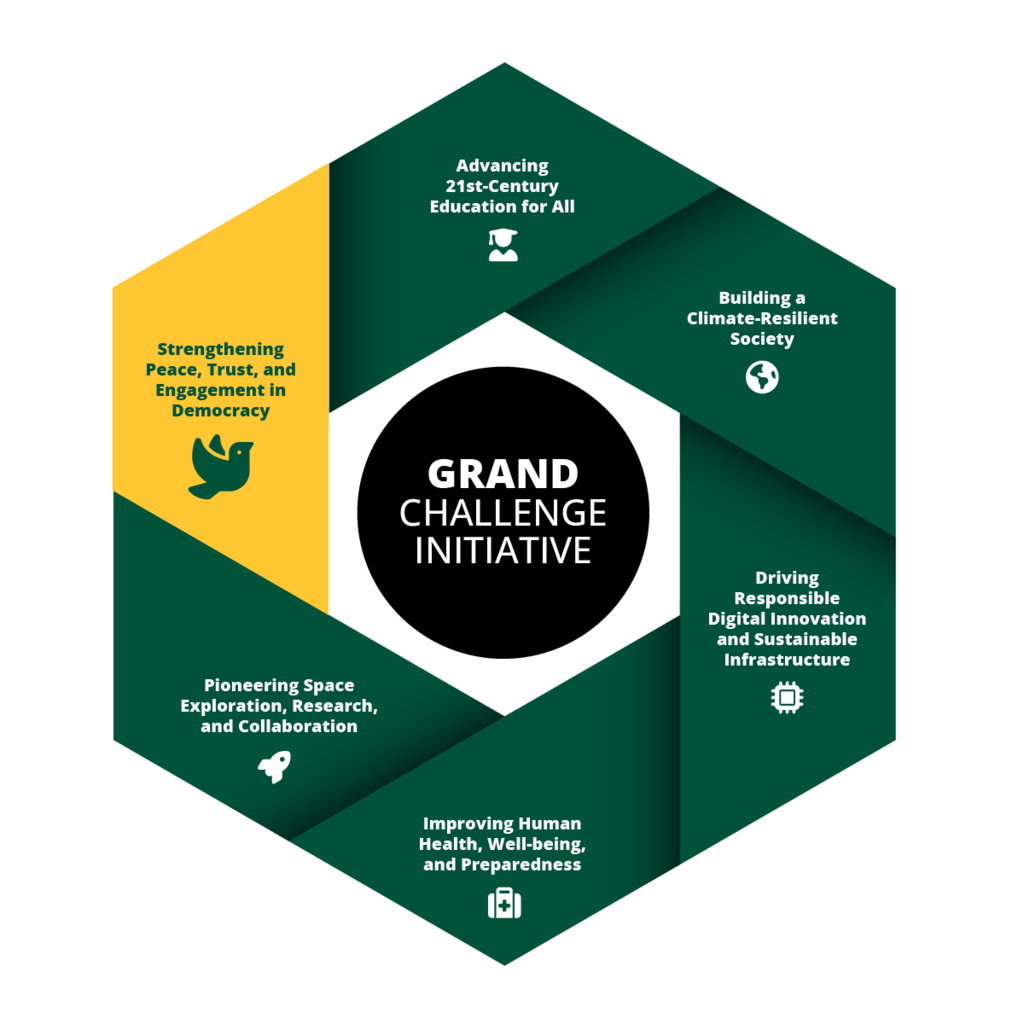
George Mason’s Grand Challenge Initiative is a university-wide collaboration addressing humanity’s most pressing challenges through six interlocking strategies, supported by a $15 million investment over five years.
On this page
THE GEORGE MASON ADVANTAGE
George Mason chairs the United Nations SDG 16 Hub—Peace, Justice, and Strong Institutions, a position it will hold for the next three years. As hub chair, the Carter School for Peace and Conflict Resolution is responsible for education and training, research, community engagement, developing partnerships, and working with other SDG hubs to strengthen and further the United Nations’ mission of peace and justice.
Read: The Carter School named a United Nations Academic Impact Sustainable Development Goal Hub Chair
RESEARCH IN ACTION
Humanitarian Forensics and Peacebuilding
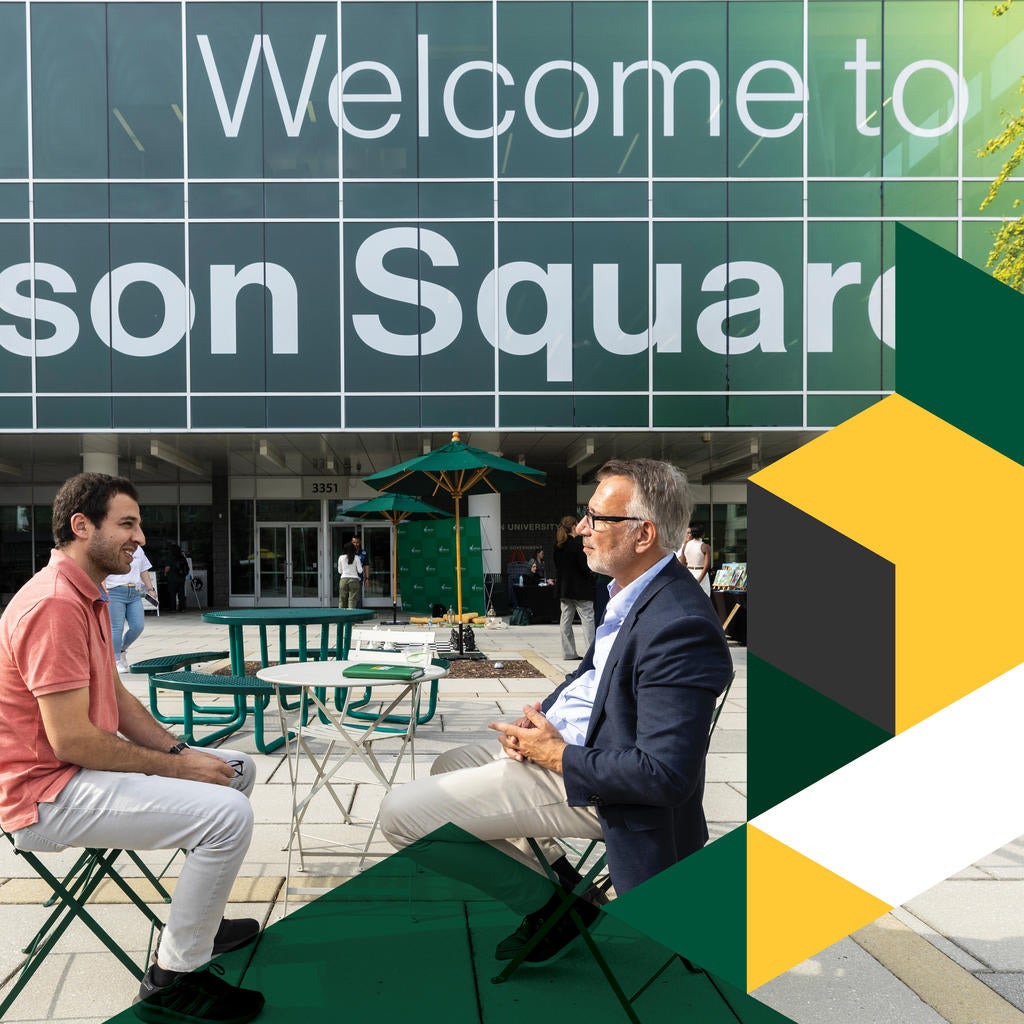
This project will build a multidisciplinary program that improves how human remains are located, identified, and reunified with families after war, disaster, or violence. Bringing together experts in forensic science, public health, peacebuilding, and international law, the project will launch a needs assessment and summer training program in the South Caucasus, along with a new course at George Mason. By integrating scientific precision with community‑centered practices, the initiative will strengthen global capacity for recovery and identification work that supports families and communities.
Learn more about the project, the colleges involved, and the cross-disciplinary leadership team.

Photo by Evan Cantwell/Office of University Branding
AI-Powered Human Rights Education for All
This project will create an AI‑driven virtual human rights classroom prototype that gives people everywhere access to practical, personalized tools to learn and apply human rights principles in daily life. Using the built‑in toolkit, users will explore interactive scenarios and receive personalized guidance to help them navigate real‑world dilemmas and assess the human rights impact of policies and technologies.
Learn more about the project, the colleges involved, and the cross-disciplinary leadership team.

Photo by Ron Aira/Office of University Branding
George Mason research initiative examines subversive campaigns and prepares students for communication careers in new areas
As debates over digital propaganda, misinformation, and media manipulation intensify, audiences are increasingly unsure what’s fact and what’s fiction across news outlets and social media feeds. At George Mason University, Sergei Samoilenko, associate professor in the Department of Communication, is working to better understand how digital disruption and manipulation practices shape public perception.

Samoilenko (bottom center) with his team, including CARP co-founder Eric Shiraev (right). Photo provided.
The making of a Carter School conflict coach
Carter School PhD student Oakley Hill has built his academic career around Root Narrative Theory, a framework for understanding how people perceive political situations, and he conducted the first national Justice Languages of America Survey just before the 2024 presidential election. Alongside his research, Hill serves as facilitation coordinator at the Carter School's Point of View International Retreat and Conference Center, matching clients from organizations across the region with experienced mediators to help resolve their most pressing challenges.

Oakley Hill. Photo by Katelyn Smoot.
STUDENT RESOURCES
Mason Lobbies
Mason Lobbies is an annual event in which Student Government brings students down to the state capital in Richmond to lobby state legislators for legislative items that impact the university and its students. This is a way for the George Mason student body to emphasize their concerns and use their voice to make our university better for all.
Democracy Lab
In partnership with George Mason's Housing and Residence Life, the Schar School's Democracy Lab is a learning experience open to all first-year undergraduates living on campus. Through the learning community, students engage with the issues that define the journey of democracy in the United States and around the world.
Dialogue and Difference Project
The Dialogue and Difference Project aims to promote cultural, political, and social understanding through the process of community dialogue participation.
International Relations Policy Task Force
The International Relations Policy Task Force invites Schar School sophomore-, junior-, and senior-year students to engage deeply with pressing global challenges. Over the course of a year, students will pursue individual research on a topic of interest, network with subject area experts, and work collaboratively to propose policy solutions.
Jurisprudence Learning Community
For students interested in law and related careers, the Jurisprudence Learning Community offers a law school-like experience for undergraduates. Students don’t just read about the law, they simulate jury selections, analyze real Supreme Court cases, and meet judges and prosecutors.
FACULTY SPOTLIGHTS
George Mason faculty are tackling the most urgent questions of democratic resilience—from the anatomy of disinformation to the psychology of polarization. Faculty researchers collaborate across communication, policy, psychology, and data science to explore how democratic trust is built, broken, and restored.

Schar School professor Jennifer Victor studies the U.S. Congress, legislative organization and behavior, social network methods, political parties, campaign finance, organized interest groups, and lobbying. She also runs the Politics Research Lab, undergraduates and graduate students conduct research and publish on topics such as voter turnout and legislative behavior.
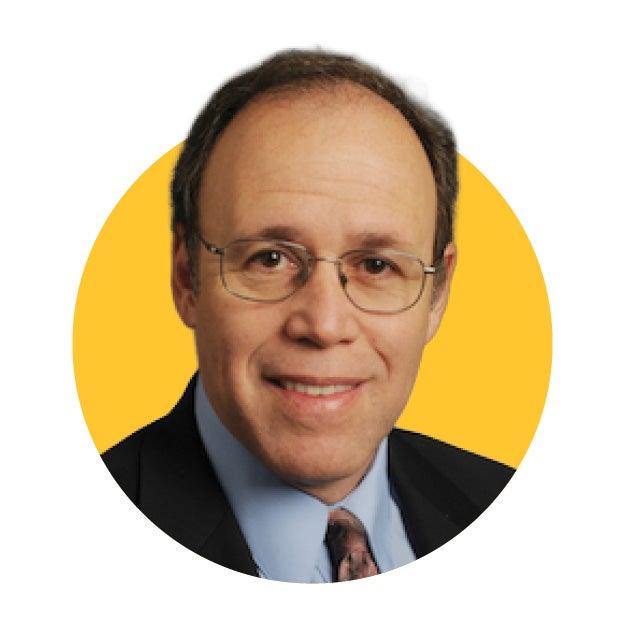
Over the decades, Marc Gopin, the James H. Laue Professor of World Religions, Diplomacy, and Conflict Resolution and director of the Center for World Religions, Diplomacy and Conflict Resolution has pioneered peacebuilding work and trained thousands of students in conflict healing and peacebuilding through intensive practice courses in conflict zones around the world.

At the Carter School’s Narrative Transformation Lab, Solon Simmons is leading efforts to develop cutting-edge narrative tools for use in practical applications in both adversarial struggles for justice and collaborative journeys toward peace.
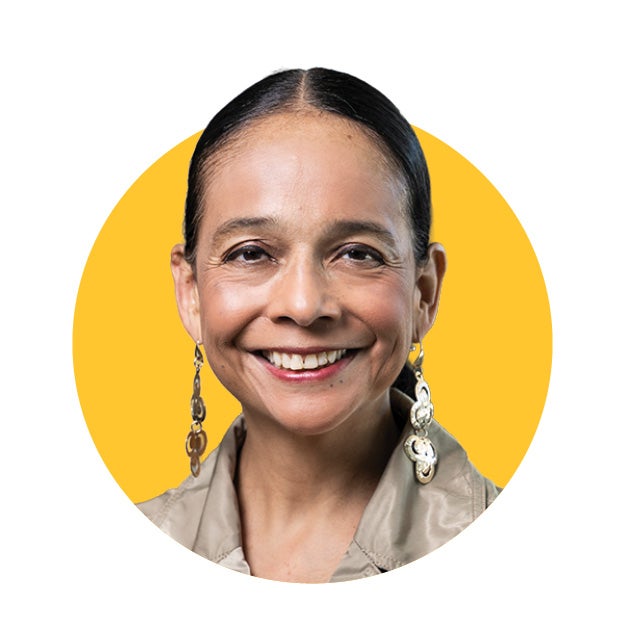
Guadalupe Correa-Cabrera is a frequent commentator on issues related to Mexican politics, U.S.-Mexico (border) relations, immigration, drug trafficking, and other forms of transnational organized crime. She was recently a Fulbright Scholar in Mexico, conducting research on human smuggling and transnational crime networks for a book.

PARTNERSHIPS AND COMMUNITY ENGAGEMENT
Rotary-Carter School Collaboration for Peace
The Carter School has partnered with Rotary International, one of the largest global membership service organizations, to provide education and develop modalities to assist Rotary clubs in promoting local, regional, and global peace.
United Nations
The Jimmy and Rosalynn Carter School for Peace and Conflict Resolution was named a United Nations Academic Impact Sustainable Development Goal Hub Chair for (SDG) 16: Peace, Justice and Strong Institutions.
FUTURE-READY INFRASTRUCTURE
Peace Labs
The Carter School Peace Labs identify, test, and enhance existing practices, tools, and models of peacebuilding and reconciliation, assessing their potential and advancing their applications across different social contexts.
Point of View International Retreat and Research Center
Set on 120 acres of pristine wooded land in Lorton, Virginia, Point of View International Retreat and Research Center is dedicated to peacebuilding practice, teaching, and research.
Clinic for Legal Assistance to Servicemembers and Veterans (M-VETS)
Founded in 2004, the Clinic for Legal Assistance to Servicemembers and Veterans, called M-VETS, enables Scalia Law students to assist servicemembers, veterans, and dependent family members in a wide variety of litigation and nonlitigation matters. Since its inception, students have assisted hundreds of clients from all five branches of the armed services.
PODCASTS
Peacebuilding amid the rise of global conflict
On this episode of Access to Excellence, President Gregory Washington is joined by Marc Gopin, the James H. Laue Professor of World Religions, Diplomacy and Conflict Resolution in George Mason’s Jimmy and Rosalynn Carter School for Peace and Conflict Resolution, to discuss the art of diplomacy by building one relationship at a time and creating a shared vision of peace.
The economic perceptions driving U.S. politics
On this riveting episode of Access to Excellence, President Washington is joined by two experts on the political process—Jeremy Mayer and Jennifer Victor, associate professors of political science in the Schar School—to discuss the impacts of polls, economic perceptions, and more on the 2024 presidential election.
NEWS
- June 23, 2026
- May 29, 2026
- May 6, 2026
- March 31, 2026
- March 18, 2026
EVENTS
Fall 2026 Peace Week — September 21–25, 2026
The Carter School's Fall 2026 Peace Week, themed "Peacemaking and Peacebuilding in a Fragmented World," will bring together scholars, practitioners, policymakers, and community leaders to explore innovative approaches to peace in an era of deepening polarization, democratic backsliding, and rapid technological transformation. Sessions will cover dialogue across divides, democratic resilience, environmental peacebuilding, and conflict transformation.