George Mason University students have key roles to play in the future of cybersecurity—and they are rising to the occasion. Over the past few years, the university has advanced as a leader in this rapidly developing field. In the 2025 Country-to-Country Capture the Flag contest, for example, only 100 finalists were invited from the world over—and five of them were from George Mason.
“Our students are focused and curious,” says Sai Manoj, an assistant professor in the Department of Electrical and Computer Engineering and advisor to George Mason hackathon participants. “And they're very interested in participating in hackathons.”
Hackathons, like PatriotHacks and other competitions such as Capture the Flag and Defend the Republic, are considered essential extracurricular activities by many students in the College of Engineering and Computing (CEC). Whether a student is passionate about hardware, software, datasets, AI-driven workflows, puzzle-solving, or flying robots, there is something for everyone.
“These competitions are an important bridge between our academic programs and the evolving demands of the technology and cybersecurity industries,” says Kamaljeet Sanghera, MS Information Systems ’00, executive director of talent development and a professor of information technology at CEC who has served as a faculty sponsor to George Mason’s annual PatriotHacks.
She says these competitions complement students’ classroom education and allow them to gain real-world, hands-on experience while networking with professionals in settings that encourage innovative thinking.
“Industry involvement definitely enriches these experiences,” says Sanghera of the companies that sponsor these competitions. “Sponsors and mentors introduce students to real-world tools, datasets, and AI-driven workflows, helping them see how their skills apply in professional settings.”
And it opens doors for these students. One George Mason student, Fatima Majid, discovered this when she placed in the top 10 at the 2025 National Defense Industrial Association (NDIA) Cyber Competition against defense professionals. She so impressed those attending that the NDIA vice president introduced himself afterward, and she had a large group of attendees interested in talking to her.
Sanghera notes that these challenges also set George Mason grads up for post-collegiate success in other ways. “They challenge students to tackle complex problems under time constraints,” she says. “Whether by developing innovative solutions in a hackathon or analyzing and defending systems in a Capture the Flag competition, both experiences help students build technical skills, while also strengthening essential soft skills such as teamwork, communication, problem-solving, and creative thinking.”
These events provide important lessons, too, in learning how to get up again after experiencing difficult setbacks and challenges. The recent George Mason Fail-a-Thon encouraged students to “fail forward” by judging them on ambition, creativity, and iteration instead of penalizing for mistakes. “The goal was to celebrate experimentation and meaningful learning,” says Humaira Akhtari, a term instructor in the Department of Information Sciences and Technology, who judged the event.
Students don’t have to go far to find an opportunity either. The 2025 Raytheon Defend the Republic autonomous blimp contest, for example, took place on the Fairfax Campus in EagleBank Arena.
“George Mason has a very strong background in general in security. It's not just about the faculty, but also the students and the locality,” says Manoj. “With the government and so many high-tech companies nearby, there’s a huge need for security in the area. That means that the students and faculty are seeing a lot of opportunities for growth.”
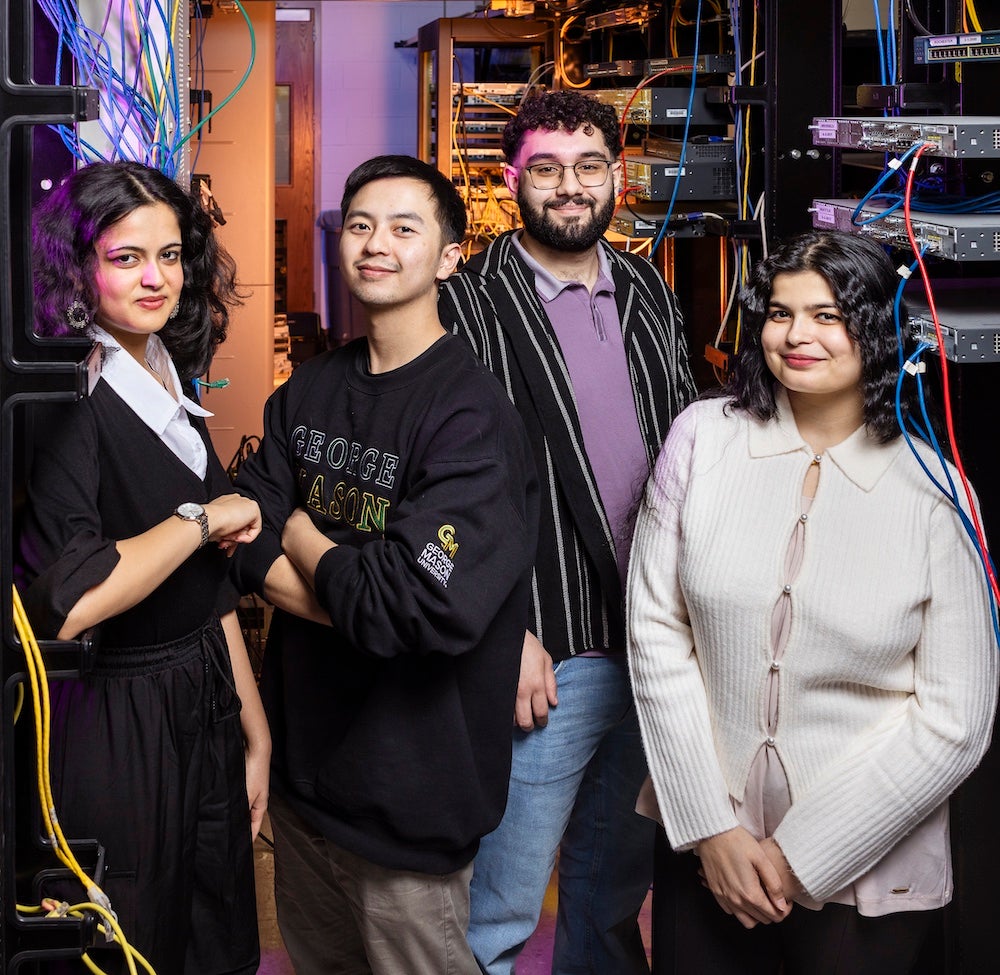
Meet a few of the George Mason students who are advancing in cyber competitions at the national level.


This content appears in the Spring 2026 print edition of the Mason Spirit Magazine.